

3 SEPTEMBER—Rabhi Abu Alia, age 17, and Omar Muhammad Naasan, age 18, were shot and killed by Zionist occupation forces during an attack on the village of Al–Mughayyir on Wednesday evening, 2 September. Naasan, who graduated from high school one month ago, is pictured above (right) on the day of his graduation. Abu Alia was photographed standing in front of the Dome of the Rock at Al–Haram Al–Sharif (the Noble Sanctuary) near Al–Aqsa Mosque.
In what follows, journalist Wisal Abu Alia—sharing the same family name and related to Rabhi Abu Alia through their grandfather—reports on the current state of siege of Al–Mughayyir.
Wisal Abu Alia’s report arrived by text this morning in the form of a letter. I publish it as it arrived.
—C. M.
By Wisal Abu Alia
Good morning,
To whom it may concern—and to those who do not know where Al–Mughayyir, northeast of Ramallah, is located: this is not merely a village on a map, nor is it a passing story in a news bulletin.
It is a village where nearly five thousand people live every day beneath a sky that always seems clouded—not because clouds never leave its skies, but because the fear and grief that have accumulated in the hearts of its people have left no room for yet another sorrow.
In Al–Mughayyir, even the calendar seems different.
Day and night are no longer separate periods of time. What happens during the day happens at night, and what begins at dawn does not end at sunset. For three years, people have forgotten what normal sleep feels like. But in recent months, the fear has become even more intense, making every moment capable of turning into a raid, a bullet, an arrest, or an assault. People live constantly on edge.
The army never truly leaves the village. It spreads through its streets, raids homes, breaks down their doors, and enters while carrying weapons and using violence. A home in Al–Mughayyir no longer means safety. A family may be gathered inside when suddenly a tear-gas grenade is thrown among them, turning the very place meant to protect them into a space of suffocation and terror. Between tear gas and bullets, people are left with nothing but their own bodies, using them to try to protect their children and themselves.
And every time a son leaves the house, his mother places her hand over her heart and waits for him to return. She does not know whether he will come back as he left—or whether he will return wounded, detained, or carried on the shoulders of others.
Then come the settlers.
They attack homes at any moment, under the protection of the occupying forces. The scene is no longer simply one in which settlers attack while soldiers stand at a distance. What is new is that the occupation forces have begun bringing settlers with them in military vehicles during raids on the village. And this makes the scene even more brutal than a mere assault.
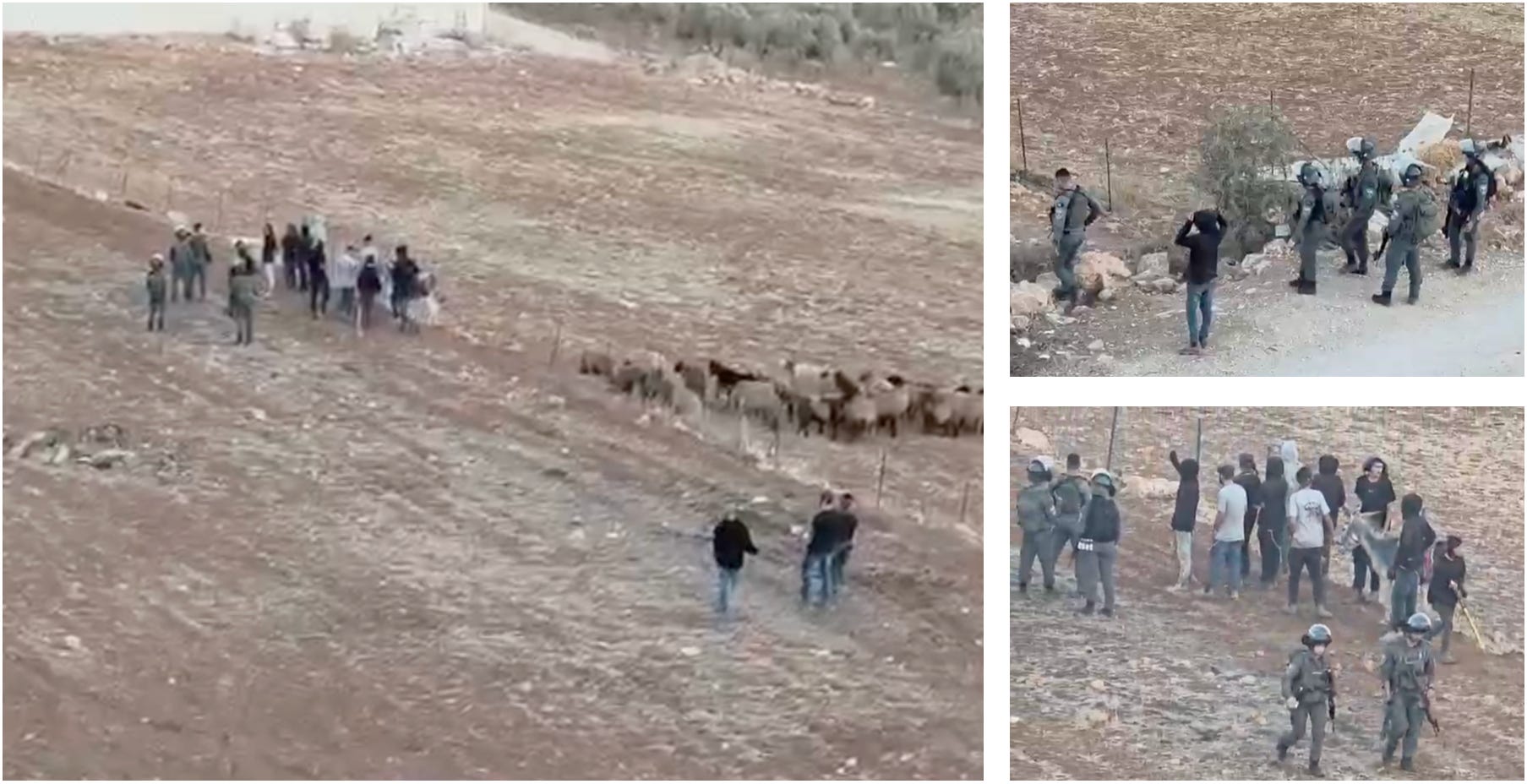
The army and the settlers operate as one force—occupying Al–Mughayyir, moving through it, and imposing their presence upon it day and night. It is as though the village is no longer merely being raided; it has become surrounded by a force that is present inside it at all times.
Even the trees have not been spared. Trees are uprooted just as homes are torn apart, because a tree on this land is not merely wood. It is memory, livelihood, an extension of a family, and a witness that someone was here—and intends to remain here.
In Al–Mughayyir, there are families who raise sheep and depend on what they produce for their livelihoods. It is a simple life built around the land, what it gives, and the hard work and patience of those who depend upon it. Yet the occupation protects settlers when they come to steal these sheep. And when residents try to defend their homes and their livelihoods, the result is often bloodshed.
Occupation snipers take positions on rooftops, waiting for the moment when residents attempt to defend their homes and their sheep—and people are killed. This is how defending your home becomes an accusation, protecting your livelihood becomes a risk to your life, and simply remaining where you are becomes an act for which you may pay with your blood. And the attacks are no longer confined to homes.
At the entrance to Al–Mughayyir, vehicles are smashed, with people inside them, by settler attacks. And there, at the permanent checkpoint, another story of humiliation begins. Workers and employees who spend an entire month working to bring their salaries home to their families may have those salaries stolen before they ever reach their homes. Soldiers from the occupation forces take them at the permanent checkpoint at the village entrance. And all of this happens only when they, the villagers, are allowed to leave or return in the first place.
The checkpoint may open for only a few minutes, and most of the time it remains closed. Reaching the village is like trying to cross a border that never ends, while returning home becomes a matter determined by the mood of the soldiers at the checkpoint rather than a person’s right to reach their own home. At this checkpoint, hundreds have been subjected to beatings, degrading treatment, and humiliation.
Al–Mughayyir is not merely living under siege. It is living within an entire system of daily pressure:
A checkpoint that closes the road.
An army that raids homes.
Settlers who attack residents.
Bullets that tear into bodies.
Sheep that are stolen.
Trees that are uprooted.
Salaries that are taken.
Arrests that continue.
And vehicles smashed over the heads of those inside them.
Today, during almost every raid on a home, hardly anyone is spared from violence.
Children. Men. Women.
Everyone stands equal before the butts of occupation rifles.
The question in Al–Mughayyir is no longer: Who is being targeted? The question has become: Who is left outside the circle of those being targeted? Hundreds of people in the village—men, women, and children—have been injured. Some injuries have left their victims facing a lifetime of pain, including cases of limb amputation caused by gunshot wounds.
At the same time, the space in which life itself can exist continues to shrink. Al–Mughayyir once had approximately 43,000 dunams of land (10625 acres). Today, only around 980 dunams (242 acres) remain. And even this remaining area changes from one day to the next, revealing that the struggle is not merely over a house, a street, or a tree. It is a struggle over the village’s right to continue existing on its own map.
Land that once had room for an entire village is now shrinking until its people can barely breathe. Even vendors have stopped entering Al–Mughayyir because they fear attacks by settlers. And so it is not only the road that is closed to people. The doors to the market, to work, to movement, and to life are closed as well.
This is how isolation is created, step by step:
The entrances are closed, so people become afraid to come.
Vendors are afraid to enter.
Workers and employees are trapped.
Salaries are stolen.
Vehicles are attacked.
Homes are raided.
Doors are broken down.
Tear-gas grenades are thrown inside homes.
Men, women, and children are beaten.
Trees are uprooted.
Sheep are stolen.
Arrests continue.
And snipers take positions on rooftops.
Then people say that the village lives in isolation. But this isolation is not a natural fate. It is deliberately created. Today, Al–Mughayyir is experiencing an unprecedented state of siege and isolation, to the point that reaching it has become a daily battle.
A battle to reach your home.
A battle to return to your family.
A battle to protect your sheep.
A battle to protect your tree.
A battle to bring your salary home to your children.
A battle to leave the village and return to it.
And an even greater battle simply to remain.
And here lies the harshest truth:
The aim is not only to make people afraid, but to make them exhausted. Not only to injure them, but to strip them of their ability to carry on. Not only to uproot a tree, but to push a person into uprooting themselves. Uprooting does not begin when a house is demolished. It begins when the road to that house becomes impossible.
And,
When going to work becomes dangerous.
When a livelihood becomes vulnerable to theft.
When a father fears for his son.
When a mother fears for her child.
When a shepherd fears for his sheep.
When a farmer fears for his trees.
And when night becomes nothing more than an extension of the day in fear.
And yet, Al–Mughayyir remains steadfast and deeply rooted. Nearly five thousand people still live there, despite everything. Mothers still wait for their sons. Shepherds still go out to tend their sheep. Farmers still look upon their trees. Homes, even with their doors torn from their hinges, still say that their owners are here. And the village, despite the siege, refuses to become a place without its people.
That is why the real struggle does not seem to be only about Al–Mughayyir. It is a struggle over what it means for a human being to have a place to which they can return.
When a place is besieged, the human being is put to the test.
When a tree is uprooted, memory is put to the test.
When a road is closed, the right to access is put to the test.
When a child is terrorized, the future is put to the test.
And when a village’s people are pushed to leave, the very meaning of homeland is put to the test.
And Al–Mughayyir, through everything happening there, says one thing: We are not defending a few dunams of land. We are defending our right to have a tomorrow here.
This is not the whole story of Al–Mughayyir. It is only a small part of what happens every day in a village besieged by the occupation and settlers, where its people live under fear, gunfire, assault, and isolation.
But perhaps this small part is enough to make us ask:
How much more land must be uprooted?
How many more people must be injured?
How many more homes must have their doors torn down?
How many more salaries must be stolen?
How many more trees must be uprooted?
How many more mothers must place their hands over their hearts every time their sons leave home?
How many more times must an entire village have its roads closed?
How much more must happen before those who have the power to listen understand that what is happening in Al–Mughayyir is not an isolated incident, but a daily attempt to uproot people from their land, their livelihoods, their memories, and their right to live?
Al–Mughayyir is not simply a village that cannot sleep. Al–Mughayyir is a village that is being forced not to sleep, so that it will become too exhausted to remain. But, for now, it is still here. And that alone, in an age of dispossession, is an act of resistance.
■
Published simultaneously at West Bank Alerts.
If you appreciate what you read, please consider supporting this work. You can become a paid subscriber by clicking on the button below. You can “buy me a coffee.” You can send a one-time, monthly, or yearly donation via PayPal. Or you can support me on Patreon. You can also share this commentary. Thank you.